Sunday, 16 October 2016

Film openings

Film openings

Different producers use different ways to show the openings to their film. The different types of film openings are:
  • Blank screen
Blank screen is most commonly used as it's mainly used in low budget films.Usually a white typeface is used on a black background to create a high contrast for the audience or provide a sense of mystery to the film. Blanl screen seems to be more music focused as it relies on heavily bombarded sounds to create a sense of the atmosphere in the film.
  • Still images
Still images indicate a move past just text but also a way to incorporate text with a visual image to hint the genre of the film. requires combining different media to make the background for the title sequence. The use of music in the film opening alongside still images help to introduce the tone of the film and help hint the genre it could be.
  • Moving images
Moving images incorporate the credit titles with the moving images, translating the images behind the titles, to form patterns and illusions. Typically, this type of title sequence has no dialogue and is mainly music based. It also focuses more on the image and the plot or the context rather than the credits.
  • Animation/motion
Animation/motion was most common during the 1990s and it involves integrated moving pictures with the titles. It used more digital technology and stylised editing.

My favourite type of title sequence is 'Still images' because it includes hand drawn broaders. For example: Kyle Cooper's Wimbledon title sequences seems to be more creative and abstract, adding to the tone of the film.


Wimbledon title sequence - Watch the Titles

Favourite film analysis

"Stuck in Love"

William Borgens is an acclaimed author who hasn't written a word since his ex-wife Erica left him 3 years ago for another man. In between spying on Erica and casual romps with his married neighbour Tricia, Bill is dealing with the complexities of raising his teenage children Samantha and Rusty. Samantha is publishing her first novel and is determined to avoid love at all costs - after all she's seen what it has done to her parents. In between hook ups, she meets "nice guy" Lou who will stop at nothing to win her over. Rusty, is an aspiring fantasy writer and Stephen King aficionado, who is on a quest to gain 'life experiences'. He falls for the beautiful, but troubled Kate and gets his first taste of love and a broken heart. A tale of family, love (lost and found), and how endings can make new beginnings. There are no rewrites in life, only second chances. (http://www.imdb.com/title/tt2205697/) 

Title credits:

1) Informant media presents
2)MICA entertainment & the solution entertainment group- Association
3)Informant films- Production
4)'Stuck in love'-Title
5)Greg Kinnear- Main actor
6)Jennifer Connelly- Main actress
7)Lily Collins-Main actress
8)Logan Lerman-Main actor
9)Nat Wolff-Main actor
10)Liana Liberato-Actress
11)Rusty Joiner&Spencer Breslin&Patrick Schwarzenegger
12)Kristen Bell
13)John Papsidera, CSA- Casting
14)Mike Mogis&Nathaniel Walcott-Music 
15)Andy Ross&Laura Katz-Music Supervisors
16)Kari Perkins-Costume designer
17)Robb Sullivan-Film editor
18)John Sanders-Production designer
19)Tim Orr-Director of photography
20)Carole Peterman-Line producer
21)Micheal A. Simpson&Eric Brenner-Executive producers
22)Patrick W. Dugan&Jeff Rice&Lisa Wilson&Myles Nestel-Executive producers
23)Judy Cairo-Produced by
24)Josh Boone-Written and directed by

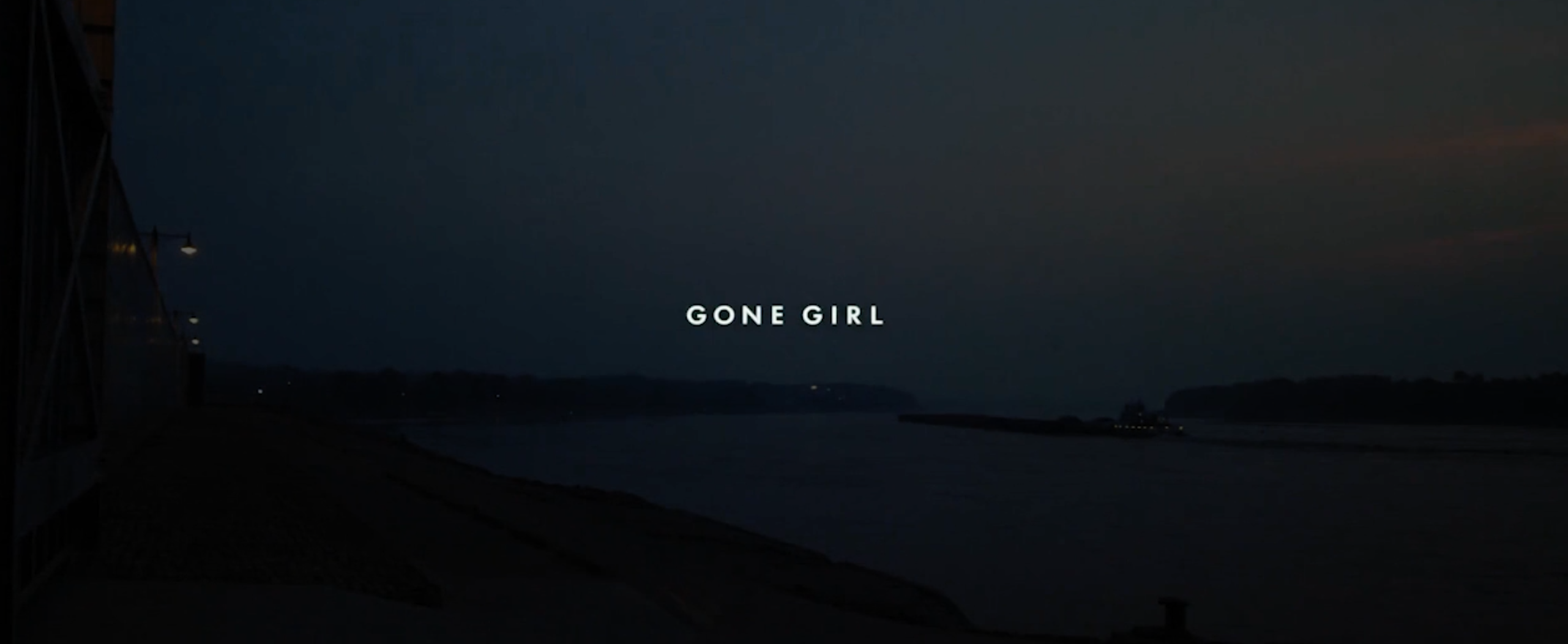
Title credits: "Gone Girl"

Title credits: Gone Girl


00:04 20th Century Fox- Production Company
00:12 Regency- Distribution Company
00:24 20th Century Fox+Regency Enterprises presents
00:26 David Fincher film-credits to director
00:53 Ben Affleck- Main leading actor
00:57 Rosamund Pike- Main leading actress
01:02 Neil Patrick Harris- Supporting actor
01:04 Tyler Perry
01:06 Carrie Loon
01:08 Kim Dickens
01:10 David Lennon+Lisa Banes
01:12 Laray Mayfield, LSA- Casting director
01:14 Ren Klyle- Sound design
01:16 Trent Reznor+Atticus Ross- Music
01:18 Trish Summerville- Costume design
01:20 Kirk Baxter- Film editor
01:22 Donald Graham Burt- Production design
01:24 Jeff Cronenweth- Director of photography
01:26 Leslie Dixon+Bruna Papandera- Exec. producers
01:28 Arnon Milche+Reese Witherspoo- Producers
01:34 Lean Chaffin+Joshua Donen- Producers
01:40 Gillian Flynn- Credits to author of novel
01:44 Gillian Flynn- Screenplay
01:49 David Fincher-Director

The typography in the title credits is kept very basic and simple in small font, cold colours. After watching the title credits I have realised that the director of the film is shown twice (beginning and end).The most popular actor's names are shown first e.g Ben Affleck. The crew's names are shown after all the key actors in the film.

TARGET AUDIANCE


So what is a Target Audience?
A target audience is a group of people ( like me and you), at which film or advertisement is aimed. the target audience is the people that you want to interest into what you are doing and releasing, because it is them who will help you build and continue.
 
To find out your target audience you need to think about..
  • what genre are you working at.
  • what age group do you want your audience to be at
  • what gender? or both genders
  • ethnicity? or is it for all.
  for example if you want your audience to be in the age group of 7-14, then you need to adjust your work to attract that age, you can do that by looking at what genre they are most into, for example animation. you will then know what props to use, what ideas to have, colours and more.

Saturday, 15 October 2016

Powered by emaze
Powered by emaze
                                    Categorising Title Sequences 

There are 4 main categories of title sequences 


  1. Titles on a blank screen -  This is the most common type, where a white type is used on a black background for contrast. It is low budget and also simple to make.   
  2. Titles on a still image  -  This is where a text is used on a still image , and it can provide some hints to the audience about the film or set an atmosphere and genre . It therefore shows more than just the credits to the film so makes it more interesting. It requires multi media to create titles on a still image. 
  3. Titles over moving image - This is where usually sound is inserted to set the right tone and atmosphere. However there is no dialogue. The moving image offers a metaphor or narrative thread to introduce the storyline. 
  4. Titles using animation or motion - This is a more complex title sequence which requires a lot of digital technology. It became more popular during the late 1990's. The titles themselves become part of the moving image and are together with the image we see. 


My favourite type of title sequence is titles over moving images , because it sets the atmosphere  and the tone. It already shows what the film may be about or where it will be set. It's more detailed than just a text on a simple background , and much more interesting to watch.